

Longevity Testing: Do You Really Need All Those Tests?
Medically reviewed by our medical team
Longevity medicine has introduced many women to a growing list of tests. These range from advanced blood panels and biological age tests to body scans and continuous monitoring.
Some tests offer useful information. Yet more data does not automatically mean better care.
Key Takeaways
- Every test should ideally answer a clear clinical question.
- Established markers such as blood pressure and cholesterol still matter most for many women.
- Advanced tests may help some women, depending on history and risk factors.
- A good question to ask: will this result change what I do?
Why Is Everyone Talking About Longevity Testing?
Wearable devices, social media, and a fast-growing longevity industry now encourage people to measure their health before symptoms appear.
A proactive approach to long term health is reasonable, especially during the hormonal transition of midlife. The challenge is knowing which results can guide real decisions.
What Are Longevity Tests Trying to Measure?
A longevity blood test often bundles many key biomarkers into one panel. Most panels and scans look at a few broad areas:
- Cardiovascular health, such as LDL cholesterol
- Metabolic health, such as fasting insulin and blood sugar
- Body composition, including muscle mass, lean mass, and visceral fat
- Inflammatory markers, such as high sensitivity C-reactive protein (hs-CRP)
- Bone health and biological aging
Each area can matter, but not every test has the same level of evidence behind it.
Does More Testing Mean More Useful Information?
Not always. Ideally, every test answers a meaningful clinical question. Testing without a clear purpose can uncover minor findings that lead to worry, repeat testing, or unnecessary follow-up.
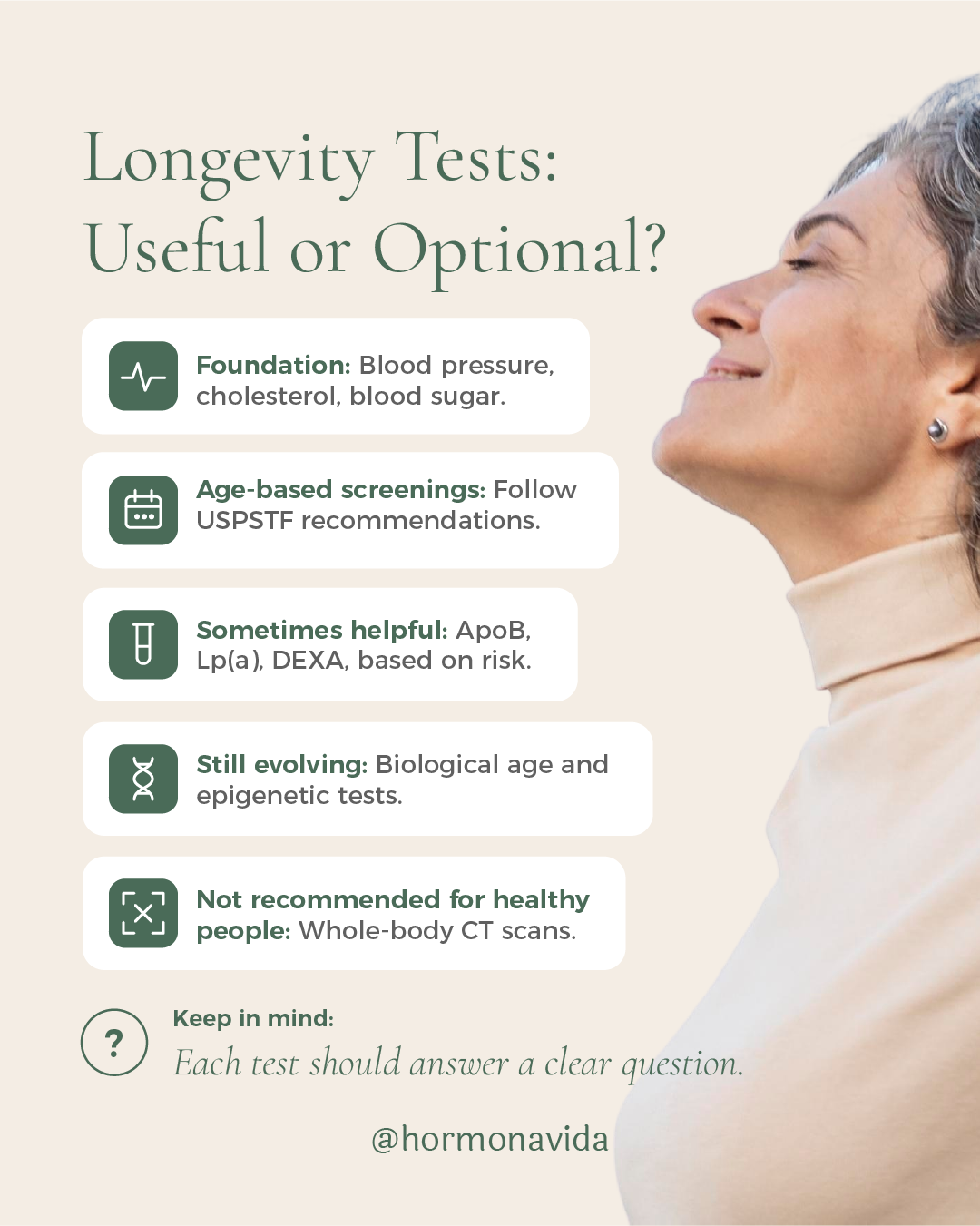
Whole-body scans show this well. The U.S. Food and Drug Administration knows of no scientific evidence that whole-body CT screening helps healthy people. For people without symptoms, the risks may outweigh the benefits.
Which Traditional Health Markers Still Matter?
Established measures remain the foundation of preventive care. CDC guidance on heart disease risk factors names high blood pressure, high cholesterol, and smoking as key risks.
Blood testing for glucose and cholesterol, plus recommended screenings, also matters. The U.S. Preventive Services Task Force publishes the screenings it recommends by age and risk.
What About ApoB, Lp(a), Insulin, or Body-Composition Scans?
Advanced diagnostics can sometimes add valuable information. Whether they help depends on your age, family history, symptoms, and existing risk factors.
For example, a strong family history of early heart disease may make lipid markers worth a closer look. Our article on Lp(a), ApoB, and LDL explains what these heart tests can show. A DEXA scan for body composition may help some women track muscle and fat over time. Still, not everyone needs every test available.
Do You Need to Measure Your Biological Age?
Biological age and epigenetic tests are an evolving area of research. Results may be interesting, but they should not replace established clinical risk assessment.
Our guide to biological age tests explains what these results can and cannot tell you.
Can Testing Become Too Much?
Yes. Constantly monitoring biomarkers and trying to optimize every number can create stress. Normal day-to-day variation may be mistaken for a problem.
Which Questions Should You Ask Before a Test?
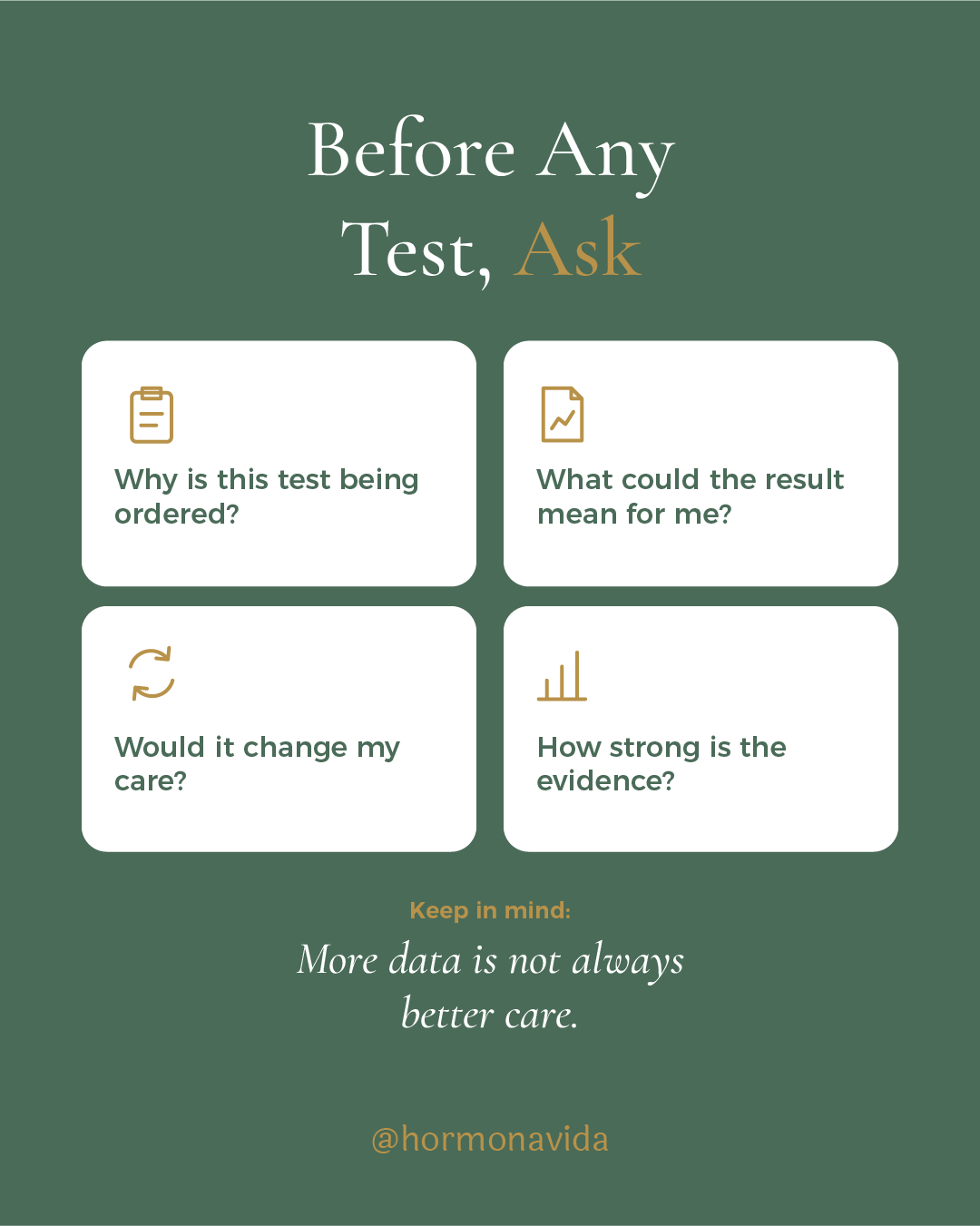
MedlinePlus notes that the screenings you need depend on your age, sex, overall health, family history, and risk factors. Before any test, consider asking:
- Why is this test being ordered?
- What could the result mean for me?
- Would it change my treatment or recommendations?
- How strong is the evidence behind it?
Key Takeaway
Longevity is not a competition to collect the most health data. Testing is most useful when the information has a clear purpose and can guide meaningful decisions.
For many women, established basics may offer more value than the newest test. At Hormona Vida, we use testing as part of structured, continuity-based care.
Wondering Which Tests Make Sense for You?
Your testing plan should reflect your history and goals, not trends. To review which evaluations may be appropriate for you, Speak With Our Care Team.
Frequently Asked Questions
What is longevity testing?
Longevity testing refers to tests that look for health risks before symptoms appear, such as heart, metabolic, and body-composition markers.
Are full-body scans worth it?
The FDA has found no evidence that they help healthy people, and they can cause false alarms.
References
Centers for Disease Control and Prevention. (2024). Heart disease risk factors. U.S. Department of Health and Human Services.
MedlinePlus. (n.d.). Health checkup. U.S. National Library of Medicine.
U.S. Food and Drug Administration. (2017). Full-body CT scans: What you need to know.
U.S. Preventive Services Task Force. (n.d.). A and B recommendations.